

购物车中还没有图书,赶紧选购吧!
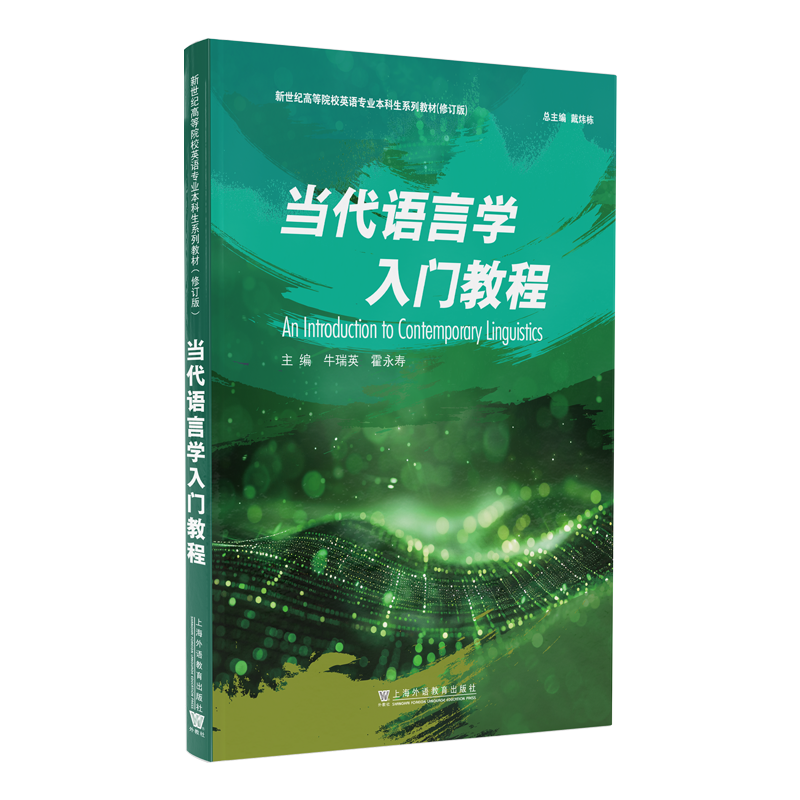
新世纪高等院校英语专业本科生系列教材(修订版):当代语言学入门教程
促销时间
距结束
00
:
00
:
00
:
00
书号
9787544686372
尚 外 价
降价通知
累计销量0
手机购买
图书二维码
配送
服务
可用积分
可用 0
数量
库存  
温馨提示

【声明】
本商城所售图书仅可作为个人学习使用,倘若用作他途(如用于商业获利等),所产生的一切后果请自负!

【退换货规则】
1、因商品质量问题需退换货,请您在收到商品之日起七日内联系客服进行申请,并根据客服的指引进行退货操作。
2、收到商品之后如需申请七天无理由退换货,请您在签收之日起七日内联系客服进行申请,并提供证据。逾期将无法受理。
3、退货地址: 请和客服联系。电话: 021-65425300转2039/2777;或在线联系。
4、请在下单后14天内申请开票,逾期财务封账将无法受理;如产生退货,已开发票将作废。

  • 属性
  • 介绍
  • 目录
手机购买
图书二维码
加入购物车
价格:
数量:
库存  个

图书详情

图书名称 :新世纪高等院校英语专业本科生系列教材(修订版):当代语言学入门教程
书号 :9787544686372
版次 :1
出版时间 :2026-06-01
作者 :牛瑞英, 霍永寿, 主编
开本 :16

介绍

《当代语言学入门教程》是广东外语外贸大学团队为英语专业本科学生的“语言学导论”课程编写的教材。根据《普通高等学校本科外国语言文学类专业教学指南——英语类专业教学指南》,“语言学导论”是英语专业核心课程的必修课程,其宗旨为“培养学生对人类语言的理性认识,提高学生的语言文化意识和思辨能力”。依据这一宗旨,本书的内容覆盖了语言学的各个层面,从聚焦语音、音位、形态、句法、语义和语用涉及语言本体的主要分支学科,到探索语言和社会、历史、认知、心理的关系的交叉学科,一直到解释语言是如何学会以及如何有效教授语言的应用语言学学科,以便学生形成对语言学概貌较全面的认识。


前言

《当代语言学入门教程》是一部专为英语专业本科阶段“语言学导论”课程编写的教材。根据《普通高等学校本科外国语言文学类专业教学指南—英语类专业教学指南》(以下简称《指南》),“语言学导论”作为英语专业核心课程的必修课程,宗旨为“培养学生对人类语言的理性认识,提高学生的语言文化意识和思辨能力”。依据这一宗旨,本书构建了涵盖语言学核心领域与延伸维度的知识体系。内容架构上,既聚焦语音、音位、形态、句法、语义和语用等涉及语言本体的主要分支学科,亦探索语言与社会、历史、认知、心理等交叉学科的关系,以及第一语言习得、第二语言习得、语言教学等应用语言学领域,旨在帮助学生形成全面的语言学认知框架。

依据《指南》和“语言学导论”课程的特点,本书明确设定三个撰写目标:其一,知识传授,让学生了解人类语言的本质特征,以此为基础了解和掌握语言学各分支学科的基本知识、概念和理论,从而形成对学科体系的整体性、综合性认知;其二,能力培养,训练学生运用语言学概念和理论分析、阐释各类语言现象的意识和能力;其三,素养提升,着力提升学生针对语言学学科内容的学术表达能力,增强学生对世界各国不同语言(特别是英汉异同)的认识,培养学生的语言文化意识和思辨能力,实现价值引领与知识传授、能力培养的有机统一。

为实现上述目标,本书的编写遵循以下三大原则:

第一,精心遴选教材内容。“语言学导论”是英语专业学生的入门语言

学课程,鉴于教学时长的有限性与学科知识的广博性,本书在内容遴选上秉持“宽而不浅、精而不偏”的原则。本书涵盖语言学的六个分支学科(语音学、音位学、形态学、句法学、语义学和语用学)、四个交叉学科(社会语言学、历史语言学、认知语言学和心理语言学),以及三个应用学科(第一语言习得、第二语言习得和语言教学),加上第1章的概述,共14章,各章节内容由编者根据其专业知识和教学经验选定。

第二,科学设计课后练习。为实现“学练结合”的教学效果,本书构建

了分层递进的练习体系:针对知识传授目标,每章设置了判断正误题、填空题和连线题等基础题型,帮助学生夯实核心知识点;针对能力培养目标,每章配套设计了思辨性问答题,可用于课堂讨论或者书面作答,引导学生运用语言学基本概念和理论分析各类语言现象。

第三,创新设置项目学习任务。本书引入小组式项目学习模式,要求学

生围绕某一语言学专题(如英汉语构词异同)开展文献检索调查等研究性学习活动,形成书面报告并进行口头汇报,旨在提升学生的学术研究能力、团队协作精神、语言表达能力、跨文化意识和思辨能力。

此外,本书还有如下特色:提炼主要术语及关键概念,以便学生快速定位重点内容;开辟Spotlight on Chinese板块,选取汉语里的鲜活实例,将抽象的语言学理论转化为可感知的语言现象,凸显英汉对比;每章附有拓展阅读书目,全书末尾汇总各章节参考文献,为学有余力的学生提供深度研习路径;配有慕课资源、微课视频和电子课件,为教师教学与学生自主学习提供多元支撑。

本书的编写汇集了集体智慧与专业力量。编写团队由广东外语外贸大学英语语言文化学院“语言学导论”课程组成员构成,各章节编者均深耕相关专业领域,结合个人多年教学经验与研究成果,为本书贡献了可贵力量。各章的编写分工如下:王晓培负责第1章(语言和语言学概述);JamesCampion(英国外教)负责第2、3、9章(语音学、音位学、历史语言学);牛瑞英负责第4、13、14章(形态学、第二语言习得、语言教学);韩景泉负责第5章(句法学);霍永寿负责第6、7章(语义学、语用学);余盛明负责第8章(社会语言学);孙毅负责第10章(认知语言学);杨洋负责第11章(心理语言学);吴庄负责第12章(第一语言习得)。由牛瑞英和霍永寿负责统稿。

本书编写过程中,我们得到了上海外语教育出版社以及诸多同行同事的关心和支持。特别值得感念的是,“语言学导论”教学团队全体成员始终秉持严谨治学的态度,以高度的责任感投入编写工作。正是团队的坚守与付出、协作与担当,才使得本教材得以如期呈现。在此一并表示衷心的感谢!

虽然我们在写作过程中力求内容精准、语言清晰简明,但由于水平所限,错漏在所难免,敬请同行专家和广大读者批评指正,以便我们将来进一步修订和完善。

广东外语外贸大学

英语语言文化学院

语言学导论教学团队

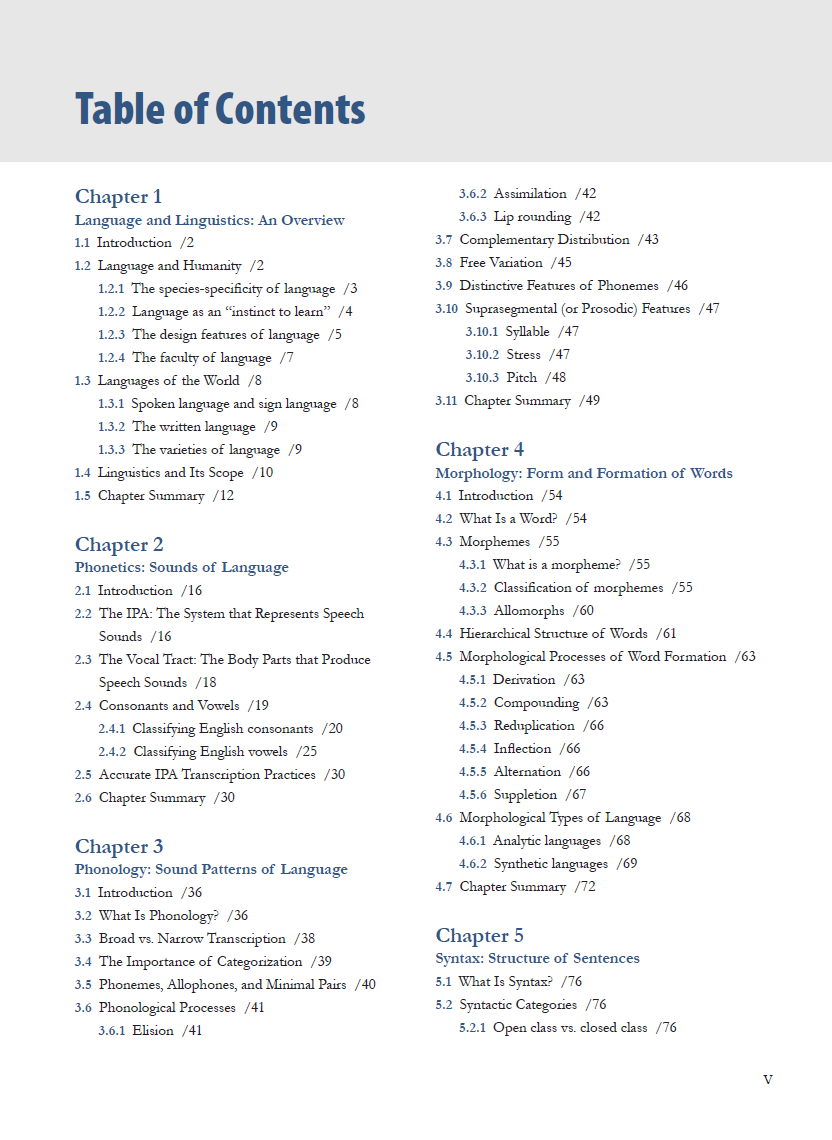
目录

Chapter 1 Language and Linguistics: An Overview
1.1 Introduction
1.2 Language and Humanity
1.2.1 The species-specificity of language
1.2.2 Language as an "instinct to learn"
1.2.3 The design features of language
1.2.4 The faculty of language
1.3 Languages of the World
1.3.1 Spoken language and sign language
1.3.2 The written language
1.3.3 The varieties of language
1.4 Linguistics and Its Scope
1.5 Chapter Summary

Chapter 2 Phonetics: Sounds of Language
2.1 Introduction
2.2 The IPA: The System that Represents Speech Sounds
2.3 The Vocal Tract: The Body Parts that Produce Speech Sounds
2.4 Consonants and Vowels
2.4.1 Classifying English consonants
2.4.2 Classifying English vowels
2.5 Accurate IPA Transcription Practices
2.6 Chapter Summary

Chapter 3 Phonology: Sound Patterns of Language
3.1 Introduction
3.2 What Is Phonology?
3.3 Broad vs. Narrow Transcription
3.4 The Importance of Categorization
3.5 Phonemes, Allophones and Minimal Pairs
3.6 Phonological Processes
3.6.1 Elision
3.6.2 Assimilation
3.6.3 Lip rounding
3.7 Complementary Distribution
3.8 Free Variation
3.9 Distinctive Features of Phonemes
3.10 Suprasegmental (or Prosodic) Features
3.10.1 Syllable
3.10.2 Stress
3.10.3 Pitch
3.11 Chapter Summary

Chapter 4 Morphology: Form and Formation of Words
4.1 Introduction
4.2 What Is a Word?
4.3 Morphemes
4.3.1 What is a morpheme?
4.3.2 Classification of morphemes
4.3.3 Allomorphs
4.4 Hierarchical Structure of Words
4.5 Morphological Processes of Word Formation
4.5.1 Derivation
4.5.2 Compounding
4.5.3 Reduplication
4.5.4 Inflection
4.5.5 Alternation
4.5.6 Suppletion
4.6 Morphological Types of Language
4.6.1 Analytic languages
4.6.2 Synthetic languages
4.7 Chapter Summary

Chapter 5 Syntax: Structure of Sentences
5.1 What Is Syntax?
5.2 Syntactic Categories
5.2.1 Open class vs. closed class
5.2.2 Morphological distribution vs. syntactic distribution
5.2.3 Lexical categories vs. functional categories
5.3 X-bar Theory
5.4 Projection of Functional Categories and Movement
5.4.1 Tense and TPs
5.4.2 Complementizers and CPs
5.4.3 Movement
5.5 Complements and Adjuncts in NPs
5.6 Structural Ambiguity
5.7 Chapter Summary

Chapter 6 Semantics: Literal Meaning of Language
6.1 What Is Semantics?
6.2 Word Meaning and Referential Semantics
6.2.1 What is word meaning?
6.2.2 Word meaning in philosophical traditions: rationalism vs. empiricism
6.2.3 Two referential accounts of word meaning: direct vs. indirect
6.2.4 Word meaning in Chinese philosophy
6.3 Word Meaning as a Semantic Triangle
6.3.1 Philosophical foundations of the triangle view of word meaning
6.3.2 The semantic triangle view of word meaning
6.4 Componential Analysis and Lexical Relations
6.4.1 Word meaning analyzed as semantic components
6.4.2 Word meaning analyzed as semantic relations between words
6.5 Proposition and Truth-Conditional Semantics
6.5.1 The concept of proposition
6.5.2 Truth conditions and truth-conditional semantics
6.5.3 Quantifying propositions: universal vs. existential
6.5.4 Types of sentence in the logical analysis of meaning: synthetic vs. analytic
6.6 Entailment and Semantic Presupposition
6.6.1 Meaning in the semantic analysis of a sentence: explicature vs. entailment
6.6.2 Negation and presupposition
6.7 Argument and Semantic Roles in a Sentence
6.7.1 Sentence as an argument structure
6.7.2 Semantic roles in a sentence
6.8 Chapter Summary

Chapter 7 Pragmatics: Meaning in Context
7.1 What Is Pragmatics?
7.2 Deixis
7.2.1 What is deixis?
7.2.2 Types of deixis
7.3 Pragmatic Presupposition
7.3.1 Presupposition triggers
7.3.2 Context sensitivity and the projection problem
7.4 Speech Acts
7.4.1 Austin's speech acts: nature and felicity conditions
7.4.2 Searle's speech acts: felicity conditions and typology
7.5 Conversational Implicature
7.5.1 Convention and implicature
7.5.2 The Cooperative Principle and conversational implicature
7.5.3 Features of conversational implicature
7.6 Politeness
7.6.1 Politeness and speech acts
7.6.2 Politeness and face: positive vs. negative
7.6.3 On-record speech acts and face management
7.7 Chapter Summary

Chapter 8 Sociolinguistics: Language and Society
8.1 What Is Sociolinguistics?
8.2 Related Fields of Study
8.3 The Micro-Macro Distinction
8.4 Micro-Sociolinguistics
8.4.1 Standard vs. dialect: social stratification as a factor of linguistic choice
8.4.2 Gendered speech: sex as a factor of linguistic choice
8.4.3 Communicating across generations: age as a factor of linguistic choice
8.4.4 Politeness: cultural dimensions of linguistic choice
8.5 Macro-Sociolinguistics
8.5.1 Language contact: interaction between languages
8.5.2 Code-switching: linguistic choices across language boundaries
8.5.3 Diglossia, bilingualism, and multilingualism: functional choices among varieties
8.5.4 Language and identity: cultural choices of language
8.5.5 Language planning: political choices of language
8.6 Language Change and Variation
8.7 Linguistic Relativism
8.8 Chapter Summary

Chapter 9 Historical Linguistics: Language Change over Time
9.1 Introduction
9.2 The History of English
9.2.1 Old English
9.2.2 Middle English
9.2.3 Early Modern English
9.2.4 Late Modern English
9.3 Types of Language Change
9.3.1 Lexical change
9.3.2 Semantic change
9.4 Causes of Language Change
9.5 Attitudes Toward Language Change
9.5.1 Prescriptivism
9.5.2 Descriptivism
9.6 Language Change Theory
9.6.1 Lexical gaps
9.6.2 Substratum theory
9.6.3 Functional theory
9.7 Chapter Summary

Chapter 10 Cognitive Linguistics: Language and Cognition
10.1 What Is Cognitive Linguistics?
10.2 Form, Psychology, and Cognition
10.3 The Relationship Between Language and Cognition
10.4 Metaphor and Metonymy: Classical Theories in Cognitive Linguistics
10.4.1 Conceptual metaphor theory
10.4.2 Conceptual metonymy theory
10.4.3 Conceptual blending theory
10.5 Chapter Summary

Chapter 11 Psycholinguistics: Language and Psychology
11.1 Introduction
11.2 What Is Psycholinguistics?
11.3 Speech Comprehension
11.3.1 Speech perception
11.3.2 Lexical access or word recognition
11.3.3 Syntactic parsing
11.4 Speech Production
11.4.1 Word production
11.4.2 Language planning: planning bigger units
11.5 Experimental Paradigms
11.6 Chapter Summary

Chapter 12 First Language Acquisition: Learning Mother Tongue
12.1 Introduction
12.2 Major Problems in Language Acquisition
12.3 Theoretical Approaches to Language Acquisition
12.3.1 The Generative Approach
12.3.2 The Usage-Based Approach
12.4 Acquisition of Language Components
12.4.1 Phonological acquisition
12.4.2 Lexical acquisition
12.4.3 Acquisition of morphology and syntax
12.4.4 Acquisition of pragmatics
12.5 Learning More than One Language
12.6 Chapter Summary

Chapter 13 Second Language Acquisition: Learning an Additional Language
13.1 Introduction
13.2 Defining SLA
13.3 L1 and L2 Learning Being Compared
13.3.1 The initial state
13.3.2 The intermediate state
13.3.3 The final state
13.4 Theoretical Perspectives on SLA
13.4.1 The behaviorist perspective and L2 learning theories
13.4.2 The innatist perspective and L2 learning theories
13.4.3 The cognitive perspective and L2 learning theories
13.4.4 The sociocultural perspective and L2 learning theories
13.5 Factors Causing Individual Differences in L2 Learning
13.6 Chapter Summary

Chapter 14 Language Teaching: Language and Instruction
14.1 Introduction
14.2 Theories of Language and Language Learning
14.2.1 Theories of language
14.2.2 Theories of language learning
14.3 Language Teaching Methods
14.3.1 The Grammar-Translation Method
14.3.2 The Audiolingual Method
14.3.3 Communicative Language Teaching
14.3.4 Task-Based Language Teaching
14.4 The Post-Method Philosophy
14.5 Chapter Summary

Appendix I: Reference Answers
Appendix II: Glossary
Appendix III: Bibliography
对比栏

1

您还可以继续添加

2

您还可以继续添加

3

您还可以继续添加

4

您还可以继续添加

关闭